Nightmare in El Bierzo: How to Remove Botillo Stains from Clothes and Tablecloths
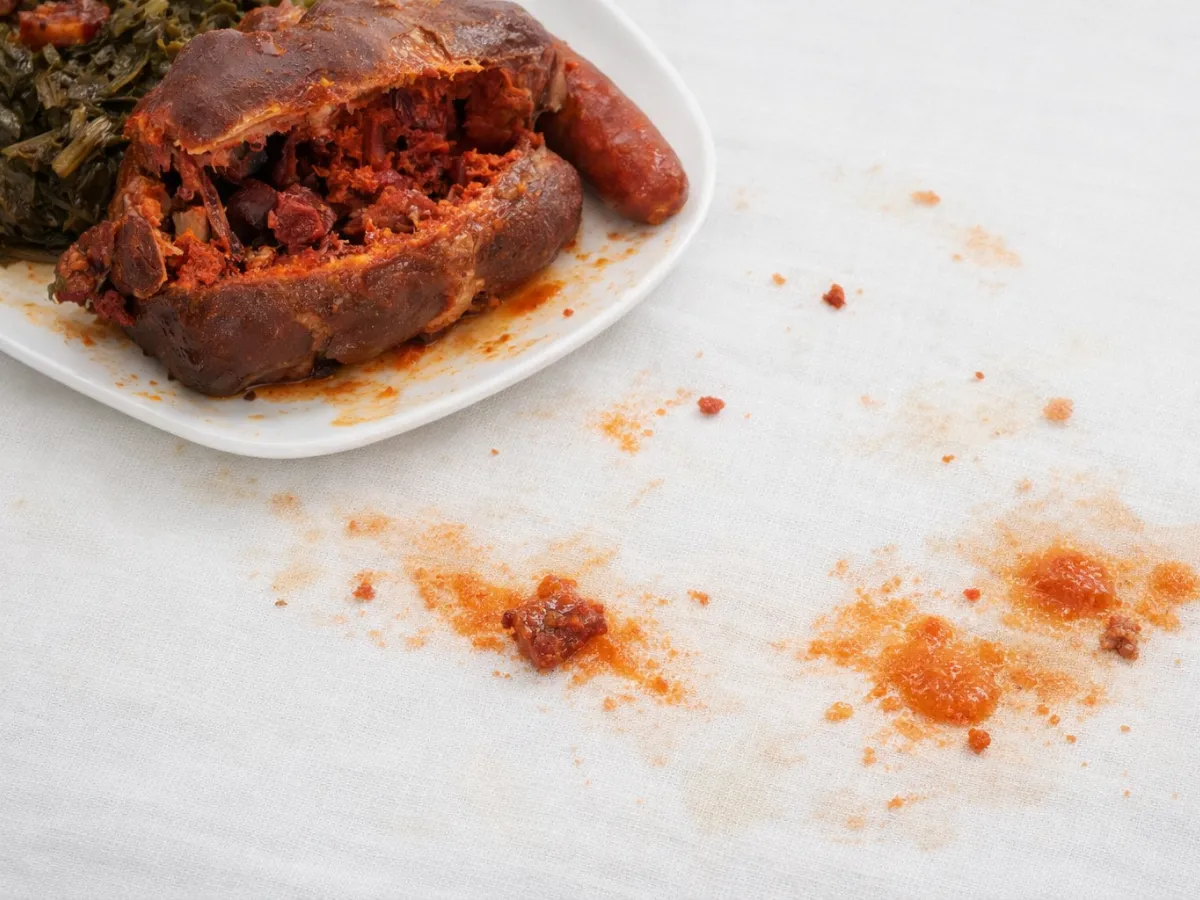
Here in Ponferrada, we know there are few things that give more pleasure than a good Botillo del Bierzo on a winter Sunday. But we also know there are few things scarier than watching that bright red juice jump directly onto your favorite white shirt or grandmother's linen tablecloth.
For those unfamiliar, Botillo is our traditional meat dish, heavy on pork fat and marinated with intense paprika. The Botillo stain is not just any stain. It is the "final boss" of household stains. Many customers arrive at the laundry giving up on the garment because, after washing it at home, an impossible-to-remove orange ring remains. If you are wondering how to clean a botillo (or chorizo/paprika) stain without leaving a trace, you have come to the right place. We are going to apply professional techniques to disarm this enemy.
Why is the Botillo Stain So Difficult? (The Science of Disaster)
To win the battle, you have to know the enemy. The difficulty of botillo lies in the fact that it is a mixed and complex stain:
- Animal Fat (Lipids): Pork provides a dense fat that, when falling hot, penetrates deeply into the fiber and solidifies when cooling, creating a waterproof barrier.
- Paprika (Pigments): The intense red comes from the carotenes in paprika. These pigments are fat-soluble (liposoluble), meaning they travel "riding" on the fat to the heart of the fabric.
The common problem: If you wash the garment directly with water and normal detergent, the water slides off the grease and does not reach the pigment to clean it. Result: the grease is half gone, but the red dye sets forever.
Emergency Protocol: The Stain is Fresh
You are at the restaurant or have just stained yourself at home. Time is money, but don't do the first thing that comes to mind.
Step 1: DO NOT Rub
It is a basic instinct, but it is a mistake. If you rub a grease and paprika stain with a napkin, you will only manage to push the pigments deeper into the fabric weave and spread the disaster area.
Step 2: Absorption (The Key to Success)
We need to get the liquid grease out before it dries.
- Remove solid pieces with a spoon or knife, carefully.
- Cover the stain generously with something absorbent: salt, talcum powder, cornstarch, or baking soda. Even bread crumbs work in an emergency.
- Let it act for 15 minutes. You will see the powder turn orange/reddish. That is a good sign: the grease is coming out of the fabric.
- Brush or shake off the powder.
Home Treatment: How to Eliminate It Completely
Once at home, forget about putting the garment straight into the washing machine. You need surgical pre-treatment. Follow this sacred order: 1. Degrease, 2. Depigment.
Phase 1: Degreasing (Breaking the Barrier)
As we have said, water does not remove botillo grease. You need a powerful surfactant.
- Apply manual dish soap (like Fairy/Dawn): Put a drop directly on the stain while dry. Do not wet the garment beforehand.
- Massage: Rub gently with your fingertip or a very soft toothbrush making circles so the soap penetrates and breaks down the grease.
- Wait: Let it act for 10-15 minutes.
- Rinse: Now yes, use warm water (never boiling at the beginning) to wash away the soap and grease.
Phase 2: The Attack on Paprika (Active Oxygen)
If after removing the grease a red shadow remains (which usually does), it is time for chemistry.
- For Whites and Tablecloths: Prepare a basin with very hot water (the maximum the label allows) and dissolve two tablespoons of sodium percarbonate (or an "active oxygen" stain remover). Leave the tablecloth soaking for at least 1 hour. Oxygen "eats" the organic pigments of the paprika.
- For Colored Clothes: Use a specific enzymatic stain remover for colors or white vinegar. Do a test on an inner seam to ensure it doesn't eat the original color.
If the stain was old and oily, I recommend reading our specific guide on how to remove dried oil stains, as the rehydration principle is similar.
DANGER! The 3 Mistakes That Set the Stain Forever
I have seen many garments ruined not by the botillo, but by what was done afterwards. Avoid this at all costs:
- The Iron is the Enemy: NEVER, under any circumstances, iron a tablecloth or shirt that still has a trace of the stain. The heat of the iron at 200ºC (400ºF) "cooks" the paprika and seals it chemically to the fiber. If you have ironed it, it is very likely that it will never come out.
- Dryer before checking: The same applies to the dryer. Always check the garment against the light before drying it. If a stain remains, repeat the process.
- Direct bleach on grease stains: Chlorine bleach disinfects, but it does not degrease well. Sometimes it sets the grease ring and yellows white fabric. Percarbonate is superior for food stains.

The Final Trick from El Bierzo: The Sun
Have you washed, used percarbonate, and there is still a very faint yellowish shadow on your white tablecloth? Don't despair.
Hang the garment in direct sunlight while it is wet. Paprika carotenes are photosensitive. The UV radiation from the sun breaks the chemical structure of the remaining pigment and makes it disappear like magic. It is the oldest and most effective natural whitener.
Frequently Asked Questions
Does lemon work for botillo stains?
Citric acid helps with the pigment, but not with the grease. Use it only in the final phase (if a red shadow remains) and carefully, as it can discolor colored clothes.
Cold or hot water?
For animal fat (pork/botillo), hot water is necessary to dissolve the lipids. But be careful: use it only after pre-treating the stain. If you put the dirty garment straight into boiling water without soap, you can "cook" the proteins and set them.
How to wash stained hospitality linens?
If you run a restaurant and deal with this daily, you need industrial enzymatic detergents and temperature-controlled cycles. Manual spot removal is unfeasible with large volumes.
Enjoying the gastronomy of our land should not cost you your clothes. With patience and following this order (absorb > degrease > oxidize), you can save that tablecloth. And remember, when in doubt with delicate fabrics, don't risk it.
Impossible Table Linens or Bulky Clothing?
If botillo has left its mark on large tablecloths, comforters, or a pile of laundry that your home washing machine can't handle with the necessary temperature and space, bring it to LaColada Ponferrada. Our industrial machines have specific high-performance programs and active oxygen dosing that can tackle even the most stubborn stains from El Bierzo.
Discover our laundromat in Ponferrada
Sebastián R.
More than 10 years at the helm of Lacolada Lavanderia Autoservicio Ponferrada and repairing industrial and domestic machinery in my spare time. You won't find unverified theories from the internet here, just real solutions tested by someone who gets their hands dirty every day.
More solutions for tough stains
How to Remove Oil Stains from Already Washed Clothes
If the grease from the botillo has dried, this is the advanced protocol you need.
How to Remove Chocolate Stains from Clothes
Like botillo, chocolate is greasy and dark. Learn how to treat it.
How to Remove Blood Stains from Clothes
Guide to eliminating persistent organic stains without setting them.