What's inside our automatic dosing system?
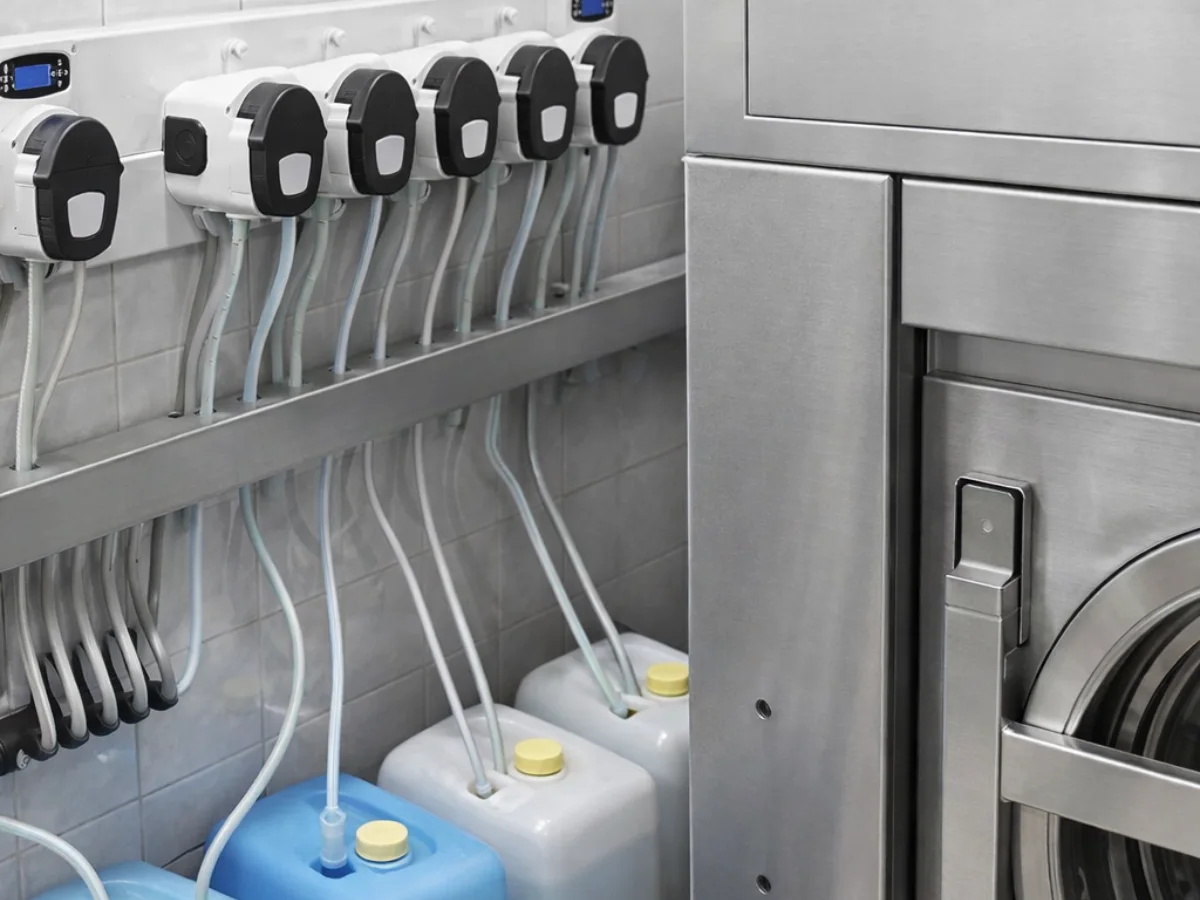
When you walk through the door of a self-service laundromat, you usually notice the obvious: the size of the drums, the cleanliness of the premises, or the smell of clean laundry in the air. That's logical. However, I'll tell you something: the real "magic" doesn't happen in the drum, but behind the wall, in a system of tubes and pumps that most people never see.
Today I want to do something different. I'm not going to give you homemade tricks or tips. Today I'm going to open the "engine room" of our laundry to explain the anatomy of a professional laundry load. I'm going to tell you why the wash you get here is technically impossible to replicate at home, and it's not due to a lack of will, but due to pure chemistry and precision.
The problem with "eyeballing" the cap
At home, dosing is an imprecise art. "Is it very dirty? I'll pour a cap and a half." "Is it a small load? Half a cap then." The problem with this method is that we have no control over the actual concentration of the product in the water (the wash bath).
In a professional laundry, "pouring a little more just in case" doesn't exist. Our automatic dosing systems inject exact amounts (measured in milliliters) of up to 4 or 5 different products at precise moments in the cycle. This isn't just to save money (industrial products are expensive), it's for safety and chemistry:
- Safety: We guarantee that no chemical residues remain on the clothes that could irritate the skin.
- Consistency: Your laundry today will turn out exactly as well as next week's.
- Efficacy: Chemical products need a specific pH and temperature to activate. If you pour the detergent at the wrong time, it simply doesn't work.
Chemical dissection: What really touches your clothes
Here is where I put on my technician hat. Many customers ask me what detergent we use so they can buy it at the supermarket. The answer is that you can't. We use separate industrial formulations that are mixed inside the machine. This is how the anatomy of our wash works:
1. Pre-wash and Alkalinity (The "Icebreaker")
The water in Ponferrada and El Bierzo has its particularities. To start, we need to prepare the ground. We don't use a simple soap; we inject a high alkalinity detergent. Why? Because we need to raise the pH of the water quickly. This causes the clothing fibers to "swell" and open up, allowing embedded dirt, grease, and proteins to release much easier than with a domestic neutral detergent.
2. Wetting Agents and Emulsifiers (The Precision)
Sometimes water alone doesn't wet well. It seems contradictory, but the surface tension of water prevents it from penetrating very dense fabrics or grease stains. Our system injects specific surfactants whose sole function is to reduce that tension. They make the water "more liquid," so to speak, penetrating to the core of the thread to drag dirt out and keep it in suspension so it doesn't stick back on.
3. Active Oxygen: Real disinfection
There is a lot of confusion here. Many people believe that to disinfect you need bleach (hypochlorite) and a pool smell. Nothing could be further from the truth. In our cycles, we use stabilized active oxygen (non-chlorinated oxidizing agents).
The technical advantage of active oxygen over household bleach is huge. While bleach burns and yellows fibers over time, active oxygen uses oxidation to break the cell membrane of bacteria and viruses without damaging color or fabric. But careful, this only works if the system controls the exact temperature and contact time. That's why at home it sometimes doesn't work the same: the machine control is missing.
4. The finish and neutralization
At the end of the cycle, the clothes cannot remain with the high pH from the beginning (it would be rough and bad for the skin). The system automatically doses a softener that not only provides a scent but acts as a chemical neutralizer. It returns the pH of the garments to the neutral level of our skin (5.5) and eliminates static electricity. It's pure chemistry applied to comfort.
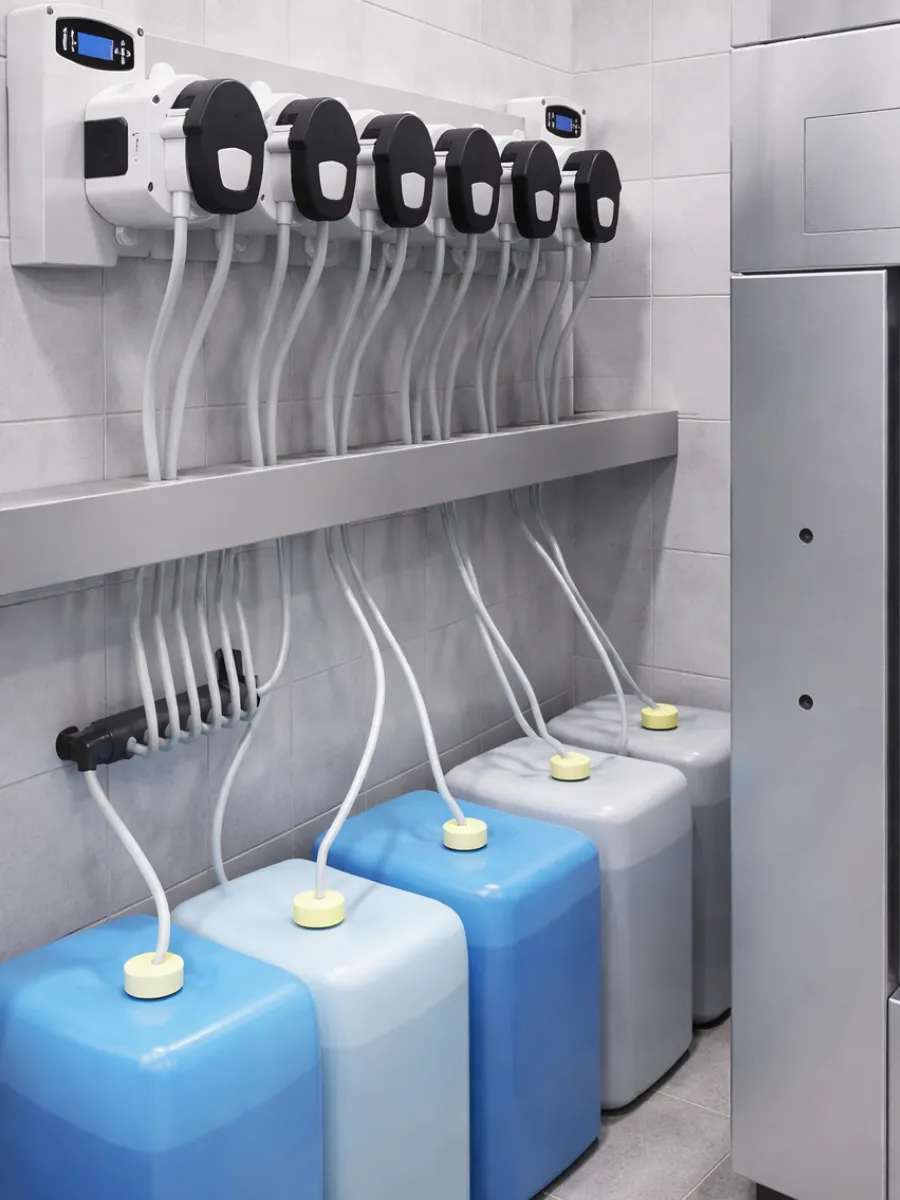
What you don't see: Invisible maintenance
As a technician, this is the part that obsesses me the most. A domestic washing machine, no matter how good, accumulates residues in the seals, the drawer, and the outer tub (where you don't see). That generates the famous biofilm: a gelatinous layer of bacteria and fungi.
In our professional system, we don't allow this. Apart from washing products, the system has maintenance protocols with acid descalers and specific disinfectants for internal circuits. When you come to wash here, I guarantee the machine is sanitized. It's not just that the clothes come out clean, it's that the machine you wash in is clean. That is a hygiene guarantee that, unfortunately, is very difficult to maintain in a domestic washing machine over the years.
Why does this matter to you?
I'm not telling you all this to bore you with chemistry lessons, but so you understand the peace of mind the service offers. When you close the washing machine door at our premises, you aren't "trying your luck." A calibrated industrial process is set in motion where:
- Health is prioritized (real disinfection).
- The environment is cared for (by dosing exactly, we don't pollute water with excess soap).
- Your investment is protected (your clothes last longer because we don't chemically attack them by mistake).
The next time you see the drum spinning, you'll know that behind that wall, a system is working with watchmaker precision to care for your garments.
Sebastián R.
More than 10 years at the helm of Lacolada Lavanderia Autoservicio Ponferrada and repairing industrial and domestic machinery in my spare time. You won't find unverified theories from the internet here, just real solutions tested by someone who gets their hands dirty every day.
Dive Deeper into Laundry Hygiene and Chemistry
Active Oxygen vs. Bleach: Which disinfects better without damage?
We chemically analyze the differences between both and why we prioritize active oxygen in our laundry.
How to properly disinfect clothes in the washing machine
Disinfection isn't magic; it's temperature and chemistry. I explain the parameters needed to eliminate bacteria.
Why does the washing machine smell bad? Technical causes and solution
Biofilm and soap residue are the invisible enemies. Discover why our industrial machines don't suffer from this problem.