What Types of Washing Machines Are There? Technical Guide to Choosing Right
You walk into an appliance store or search online and you're met with dozens of models, efficiency labels, motors with space-age names, and prices ranging from very cheap to astronomical. If you're wondering what types of washing machines are out there and which one you actually need, you're not alone.
I've spent years dismantling these machines in the workshop and seeing how they work (and fail) in the real world. The reality is that the classification is no longer as simple as "the white one" or "the one that opens from the top." Nowadays, choosing the wrong chassis type, motor, or installation method can mean annoying vibrations, clothes coming out damp, or a skyrocketing electricity bill.
In this guide, I'm going to break down the real market categories, beyond the advertising brochure, so you know exactly what you're buying.
1. By Load Type: The Great Divide
This is the first and most important decision, as it defines the washing mechanics and the space the machine will occupy.
Front Load Washing Machines
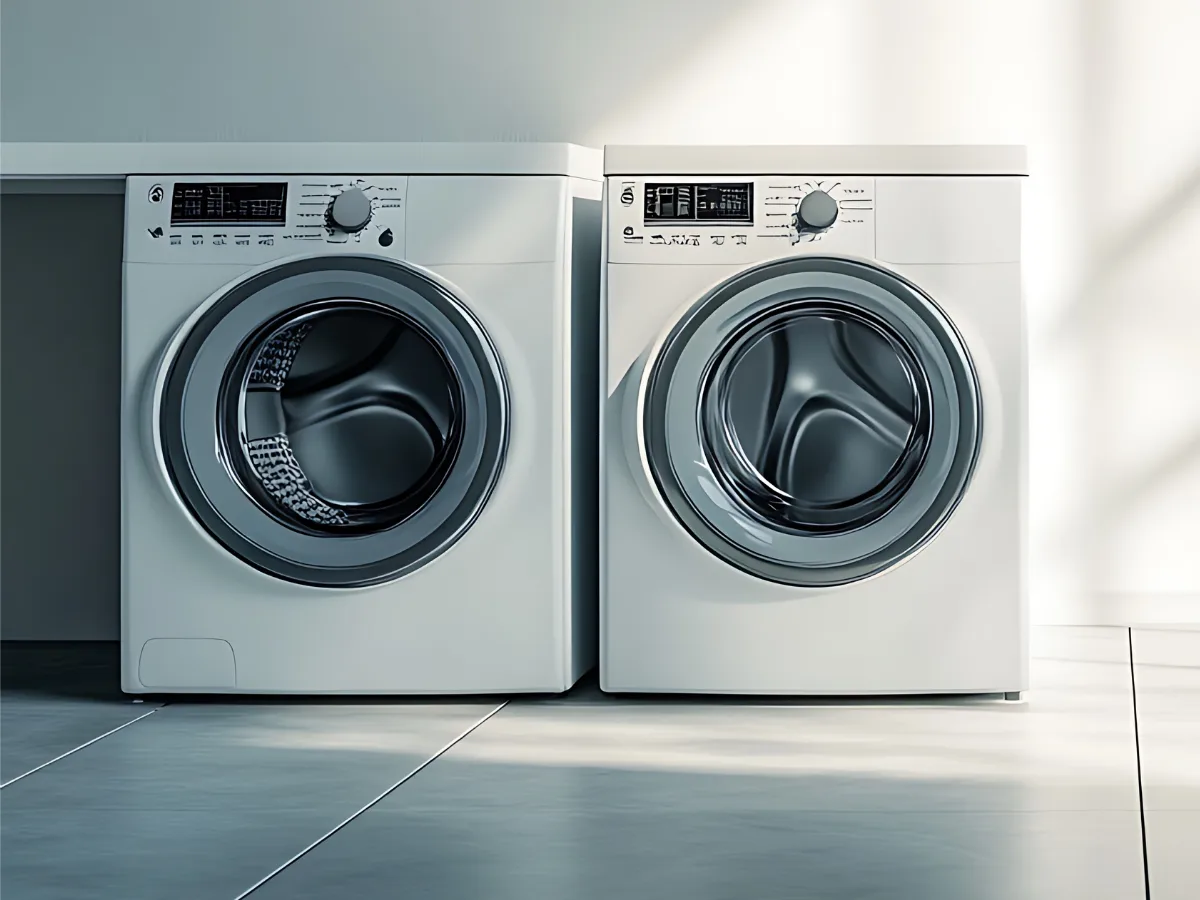
These are the standard in Europe and increasingly popular elsewhere. They feature the round door (porthole) on the front.
- Why choose them: They use gravity to move clothes (clothes tumble up and fall), making them more efficient in water and energy use. Also, they usually reach higher spin speeds.
- Key advantage: The top part remains free, so you can use it as a countertop or install a dryer on top (stacked).
- Keep in mind: If you suffer from back or knee issues, note that loading and unloading require bending down, unless you install a pedestal riser.
If you're interested in knowing how these machines expel water from clothes, check out our guide on what the spin cycle and RPM are, where we explain why front-loaders usually win in this aspect.
Top Load Washing Machines
These have the door on the top. They are the salvation for narrow bathrooms or small kitchens.
- Dimensions: They are usually narrower (about 40-45 cm wide) compared to the standard 60 cm of front-loaders (common in European markets).
- Ergonomics: You don't need to bend down to put clothes in.
- The internal system: In some regions, you see horizontal drums accessed from the top. In American or Asian models, it's common to see systems with an agitator or impeller (a post or disc at the bottom), which treat clothes differently.
- Disadvantage: You cannot place anything on top, and they often have a lower maximum capacity (kg) than large front-loaders.
2. By Installation: Visible or Hidden?
People often get confused here thinking they wash differently. They don't; it's a matter of furniture and carpentry.
Freestanding
The machine comes finished on all sides. You buy it, plug it in, and that's it. If it breaks down, it's easy to pull out and repair. It is the most flexible and economical option.
Integrated or Built-in
These are specifically designed to fit inside a kitchen cabinet.
- The visual difference: The front is flat and unattractive (with many holes and screws) because it is intended for you to screw on a wooden door matching your kitchen.
- The plinth: They have a recess at the bottom so the kitchen kickboard can pass continuously.
- Technician's tip: They are more expensive and more annoying to replace if they break. Choose this option only if your kitchen aesthetics strictly demand it.
💡 Space Problems?
If your home washing machine has become too small, has broken down, or you have a giant load (like winter duvets) that won't fit in your 7kg model, remember that at LaColada Ponferrada we have large-capacity industrial machinery. Professional washing and drying in less than 1 hour, without worrying about load type or installation.
3. The Motor: Traditional or Inverter?
Although they look the same on the outside, the "heart" of the washing machine has changed a lot in recent years. This directly affects how much your washing machine consumes.
- Brush Motor (Universal): The old-school one. It works with physical friction. It is noisier, generates more heat, and the brushes wear out over the years (a very common repair). They are cheaper.
- Inverter Motor (Direct Drive / Digital): Works using magnets, without mechanical friction.
- They are extremely quiet.
- They vibrate less (better for floors and furniture).
- They consume less electricity.
- They often have 10-year warranties just on the motor.
4. Hybrids: The Washer-Dryer Combo
Here we enter swampy territory. A washer-dryer combines both functions in a single chassis.
Are they recommended? Only if you have a severe space limitation (small apartment with no terrace or space for two machines).
The fine print:
- Unequal capacity: You can wash 9 kg, but typically you can only dry 6 kg. This means you have to take out wet clothes before starting the drying cycle.
- Eternal times: A complete wash + dry cycle can take 4 to 6 hours.
- Water waste: Interestingly, some older models use cold water to condense the steam from drying, wasting water even when drying. Always check the energy ratings before buying.
Summary: Which Washer Should I Buy?
To simplify your decision, here is my quick recommendation based on usage profiles:
| Your Situation | Recommended Type |
|---|---|
| Standard family (3-4 people), normal space | Front Load, 8-9 kg, Inverter |
| Very narrow bathroom or small kitchen | Top Load (45cm width) |
| Designer kitchen, hidden appliances | Integrated (Watch out for exact measurements) |
| Tiny apartment without drying rack | Washer-Dryer (Assuming its limits) |
| Back problems / mobility issues | Top Load or Front Load on a pedestal |
Frequently Asked Questions
How much capacity do I need?
For a single person or couple, 6-7 kg is enough. For a family of 3-4 members, the current standard is 8-9 kg. If you wash duvets regularly, look for 10 kg and up (or come to the laundromat for those large pieces).
Are there compact front-load washers?
Yes, there are "slim depth" models. They have the standard width (60 cm) but a depth of 40-45 cm instead of the usual 60 cm. They are ideal if you have a pipe behind that gets in the way or a door that hits.
What is an auto-dosing washing machine?
These are smart models where you fill a large tank with detergent and softener once a month, and the machine calculates and uses the exact amount for each wash. It saves a lot of product and cares for clothes.
Choosing the right type of washing machine will save you headaches and money in the long run. Prioritize the Inverter motor if you can afford it and measure your space well before buying. And remember, for everything your home washer can't handle, or while you wait for the new one to be installed, we are here to help.

Sebastián R.
More than 10 years at the helm of Lacolada Self-Service Laundry Ponferrada. My experience goes beyond folding clothes: I know the machinery from the inside thanks to years of technical maintenance. Here I share real tricks, without complicated theories, so you can take care of your clothes and your washing machine.
More Technical Guides
Understanding Your Washing Machine's Energy Label
Decipher the new labels (A-G) and save on your electricity bill.
How Much Does a Washing Machine Really Consume?
Analysis of water and electricity consumption by cycle and temperature.
All About the Spin Cycle: RPM and Residual Moisture
How revolutions affect your clothes care and drying time.