How Much Does a Washing Machine Measure and Weigh? A Real Installation Guide

You're designing your new kitchen layout, moving into an apartment with a suspiciously narrow elevator, or simply, your old machine has finally quit, and you need a replacement urgently. Then the million-dollar question arises: will the washing machine actually fit in that gap? And, perhaps more importantly for your back, will I be able to move it?
As a technician who has had to dismantle door frames because "the website said it was 60 cm wide," let me tell you something clear: catalog dimensions are often tricky. It's not enough to know the size of the metal box (the chassis); you have to account for the belly of the door, the protruding buttons, and the hoses at the back.
Quick Answer: European Standard
The most common front-loading washing machine (standard size) measures approximately 85 cm high (33.5"), 60 cm wide (23.6"), and 60 cm deep (23.6"). Its weight hovers around 65-75 kg (143-165 lbs).
1. Washing Machine Dimensions by Type
Not all washing machines are created equal. Depending on whether you load clothes from the front or the top, or if you're looking to integrate it into cabinetry, dimensions change drastically.
| Type | Typical Height | Typical Width | Typical Depth |
|---|---|---|---|
| Front Load (Standard) | 85 cm / 33.5" | 60 cm / 23.6" | 55 - 65 cm / 21.5" - 25.5" |
| Top Load | 90 cm / 35.4" | 40 cm / 15.7" | 60 cm / 23.6" |
| Under Counter / Integrated | 82 cm / 32.3" | 59.5 cm / 23.4" | 55 - 58 cm / 21.5" - 22.8" |
| Reduced Depth (Slim) | 85 cm / 33.5" | 60 cm / 23.6" | 40 - 48 cm / 15.7" - 19" |
The "Depth" Mystery
This is where most people get it wrong. On technical data sheets, you will often see measurements like "Depth: 59 cm". Be careful with this. That is usually the measurement of the top cover plate.
- Chassis depth: The metal box itself.
- Total depth: Includes the porthole (glass door) and protruding buttons. This can add 3 or 4 cm (1.5 inches) extra.
- Required useful depth: You need to add space for rear hoses (see installation section below).
2. How Much Does a Washing Machine Really Weigh?
If you've ever tried to move one, you know they feel like they are bolted to the floor. In fact, their weight is a necessary technical feature.
An empty front-loading washing machine usually weighs between 65 kg and 75 kg (143 - 165 lbs).
Why are they so heavy?
It's not the motor or the stainless steel drum. 80% of that "dead weight" feeling comes from the concrete blocks (counterweights) installed inside the chassis, usually above or around the drum. Without them, when the washer spins at 1,200 or 1,400 RPM, the centrifugal force would cause it to "walk" across your kitchen or laundry room.
- Front Loaders: The heaviest (65-80 kg / 143-176 lbs) due to the physics of their vertical rotational movement requiring significant stabilization.
- Top Loaders: Usually lighter, in the range of 55-60 kg (121-132 lbs), as their chassis is more compact and the balancing system is different.
- Washer-Dryers: These are the heavyweights of the group, often exceeding 80-85 kg (176-187 lbs) due to extra condensation and drying components.
3. Myth: Bigger Load Capacity = Bigger Machine?
This is a very common confusion. When we talk about an "8 kg" or "10 kg" washing machine, we are referring to the weight of dry clothes capacity, not the weight of the machine itself or its external size.
Current engineering magic allows an 8 kg washer and a 10 kg washer to have exactly the same exterior dimensions (Standard 60x60x85 cm). Manufacturers achieve this by reducing the space between the drum and the chassis or optimizing the motor.
However, to achieve that efficiency in the same space, it is crucial to understand how much a washing machine consumes compared to older models.
4. Installation Measurement Guide (Expert Tips)
Before buying, take out the tape measure and check these three critical points. If you don't, the delivery driver might have to take the machine back.
A. The "Rear Clearance" Rule
If your space is exactly 60 cm (23.6") deep, do not buy a 60 cm deep washer. You need to leave space for:
- Water inlet hose.
- Drain hose (which cannot be crushed or it won't drain).
- Power cord.
Recommendation: Always calculate that the washer will protrude about 4-5 cm (approx 2 inches) from the real back wall. If you have a standard 60 cm countertop, it is normal for the washer to stick out slightly at the front.
B. Doorways and Elevators
In many older buildings, elevators and bathroom doors can be treacherous.
- Measure the narrowest part of the door frame: Sometimes door stops subtract a vital 2 cm (1 inch).
- The lid trick: If you are missing 2 centimeters (less than an inch) of height to fit it under a counter, many washers allow you to remove the top lid ("countertop lid"), lowering the height from 85 cm to 82 cm (32.3"). Check the manual before trying this.
C. Depth with Door Open
If you have a narrow galley kitchen or an island opposite the washer spot, be careful. A front-loading washer with the door open at 90 degrees occupies about 100 - 105 cm (approx 40 inches) of total depth. Ensure you can bend down and load clothes without hitting the wall behind you.

Sebastián R.
More than 10 years at the helm of LaColada Self-Service Laundry Ponferrada and repairing industrial and domestic machinery. I have installed (and carried) more washing machines than my back would like to remember, so I know every inch and every pound of these machines well.
More About How Your Washer Works

How Much Does a Washing Machine Consume? Real Costs
We analyze electricity and water consumption so you can save on every load.
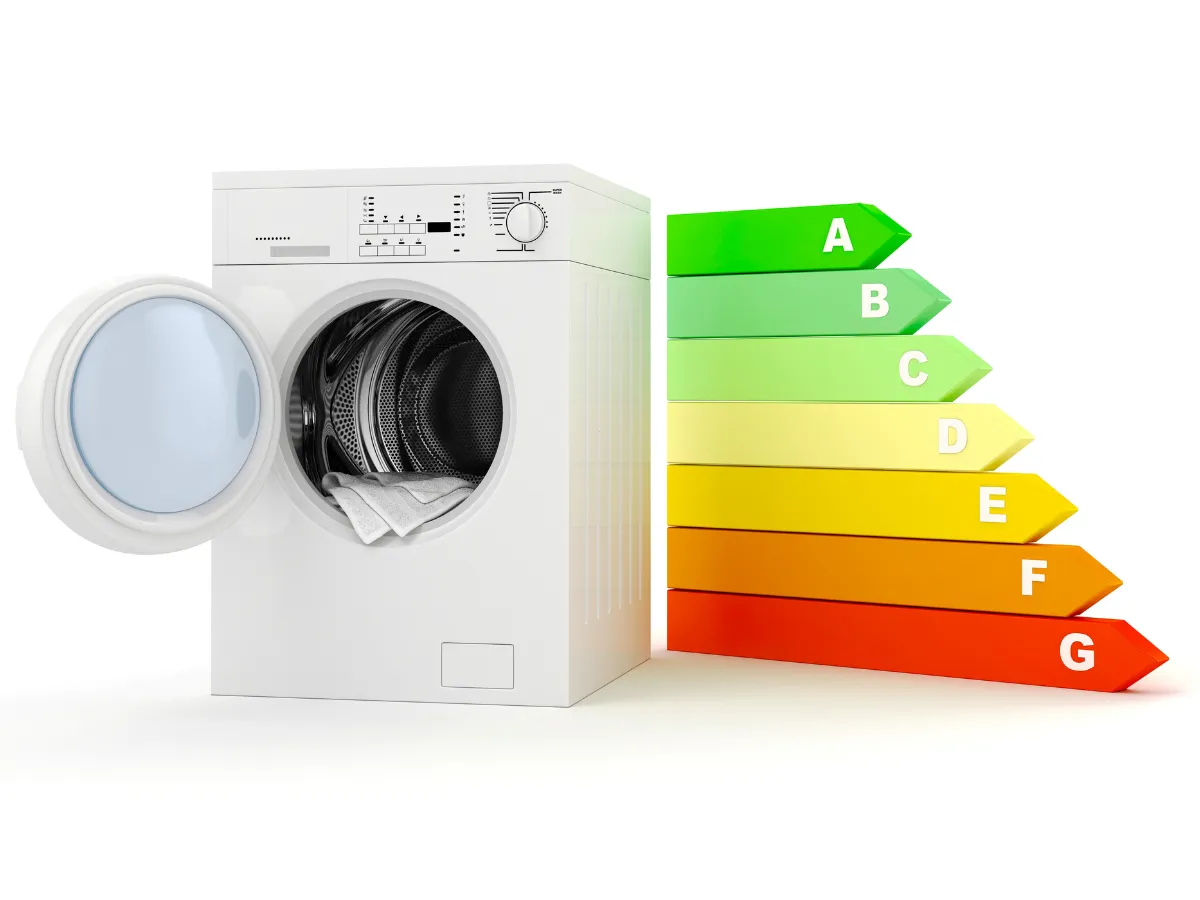
Understanding Your Washer's Energy Label
From A to G: what the new EU energy labels really mean for your wallet.

Why Is My Washing Machine Taking Longer Than Usual?
Load sensors and balancing: when the weight of clothes affects cycle time.